LLM Cost & Context Optimization Playbook (v1.1.0)
Maximizing developer velocity while minimizing LLM prompt overhead and API billing budgets is a critical priority for engineering teams. This playbook maps 12 industry cost-reduction techniques directly to native MultiModel Dev OS features.
Use when: Optimizing API token usage, configuring Caveman Mode settings, or designing modular prompt caching strategies.
Cost Optimization Matrix
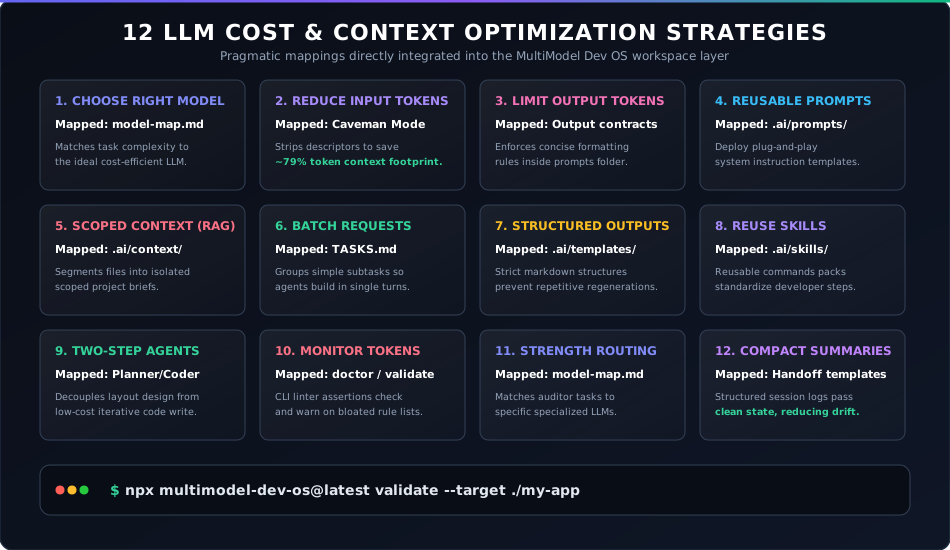
Below is how the 12 core context optimization strategies are implemented inside the workspace configuration layer:
1. Choose the Right Model
- The Strategy: Deploying premium large models (e.g. Claude 3.5 Sonnet, GPT-4o) only for high-reasoning tasks and lightweight models for simple code syntax editing.
- Dev OS Implementation: [model-map.md](file:///c:/Users/ADMIN/OneDrive/Desktop/multimodel-dev-os/.ai/context/model-map.md) stores clear instructions routing Planner, Auditor, and Scaffolder tasks to their ideal cost-efficient models.
2. Reduce Input Tokens
- The Strategy: Avoid feeding massive developer rule guides, legacy wikis, or detailed style manuals on simple prompt turns.
- Dev OS Implementation: Toggling Caveman Mode (
--caveman) strips descriptive descriptions and examples to slash prompt rules down to ~340 tokens (saving ~79% of input token context). The central [context-budget.md](file:///c:/Users/ADMIN/OneDrive/Desktop/multimodel-dev-os/.ai/context/context-budget.md) details guidelines on context sizes.
3. Limit Output Tokens
- The Strategy: Prevent models from generating verbose paragraphs, chatty conversational explanations, or redundant code structures.
- Dev OS Implementation: Decoupled prompt guidelines inside [.ai/prompts/](file:///c:/Users/ADMIN/OneDrive/Desktop/multimodel-dev-os/.ai/prompts/) enforce strict prompt output contracts (e.g. "Only output the code diff, no chat").
4. Leverage Prompt Caching
- The Strategy: Structure system prompts and context buffers to match the exact patterns that cloud providers (like Anthropic, OpenAI) require for prompt caching.
- Dev OS Implementation: Shared workspace session logs under [.ai/session-logs/](file:///c:/Users/ADMIN/OneDrive/Desktop/multimodel-dev-os/.ai/session-logs/) provide reusable, static summaries at the bottom of the prompt buffer to maximize caching hits.
5. RAG Done Right (Directory Scoping)
- The Strategy: Never feed an entire codebase to the prompt turn; instead, scope read inputs precisely.
- Dev OS Implementation: Modular files within [.ai/context/](file:///c:/Users/ADMIN/OneDrive/Desktop/multimodel-dev-os/.ai/context/) break repository information into isolated briefs (project-brief, architecture, business-rules), allowing agents to load only required profiles.
6. Batch Requests
- The Strategy: Group simple micro-features into single comprehensive execution runs instead of engaging in iterative 3-word conversations.
- Dev OS Implementation: Centralized backlog tracking in [TASKS.md](file:///c:/Users/ADMIN/OneDrive/Desktop/multimodel-dev-os/TASKS.md) structures todo steps so agents can batch scaffold logical units in one message turn.
7. Enforce Structured Outputs
- The Strategy: Enforce strict parameters to avoid wasting model cycles guessing standard format definitions.
- Dev OS Implementation: Structured template outlines in [.ai/templates/](file:///c:/Users/ADMIN/OneDrive/Desktop/multimodel-dev-os/.ai/templates/) and strict check contracts inside [.ai/checks/](file:///c:/Users/ADMIN/OneDrive/Desktop/multimodel-dev-os/.ai/checks/) guarantee predictable code blocks on the first attempt.
8. Prompt and Skill Reuse
- The Strategy: Standardize system prompts and tool commands so developers aren't authoring customized instructions from scratch.
- Dev OS Implementation: Reusable routines under [.ai/prompts/](file:///c:/Users/ADMIN/OneDrive/Desktop/multimodel-dev-os/.ai/prompts/) and custom agent scripts under [.ai/skills/](file:///c:/Users/ADMIN/OneDrive/Desktop/multimodel-dev-os/.ai/skills/) form a shared, plug-and-play prompt library.
9. Multi-Step Pipelines (Planner/Coder/Reviewer)
- The Strategy: Split high-reasoning tasks from execution runs to avoid loading massive rules files during iterative code writes.
- Dev OS Implementation: Isolated agent specs inside [.ai/agents/](file:///c:/Users/ADMIN/OneDrive/Desktop/multimodel-dev-os/.ai/agents/) deploy a two-step approach where a Planner agent outlines changes, and a Coder agent writes the diff.
10. Monitor Usage & Auditing
- The Strategy: Continuously verify that developers' rules aren't getting cluttered or exceeding token limits.
- Dev OS Implementation: Compliance assertions using
npx multimodel-dev-os validateand advisory checkups usingdoctorwarn teams when context files grow too bloated.
11. Multi-Provider Strategy
- The Strategy: Prevent vendor-lock by designing adapters to translate instructions dynamically across different LLMs.
- Dev OS Implementation: Neutral mappings configured inside
model-map.mdallow switching model endpoints instantly without refactoring the central repository contracts.
12. Embedding Hygiene
- The Strategy: Ensure semantic search indexes only relevant source files instead of temporary distributions.
- Dev OS Implementation: Strict routing specifications mapped inside
context-routing.mdand pre-configured.gitignoredefinitions protect search databases from index pollution.
Explore our Stable Protocol Specification or Upgrade & Migration Guide for details.